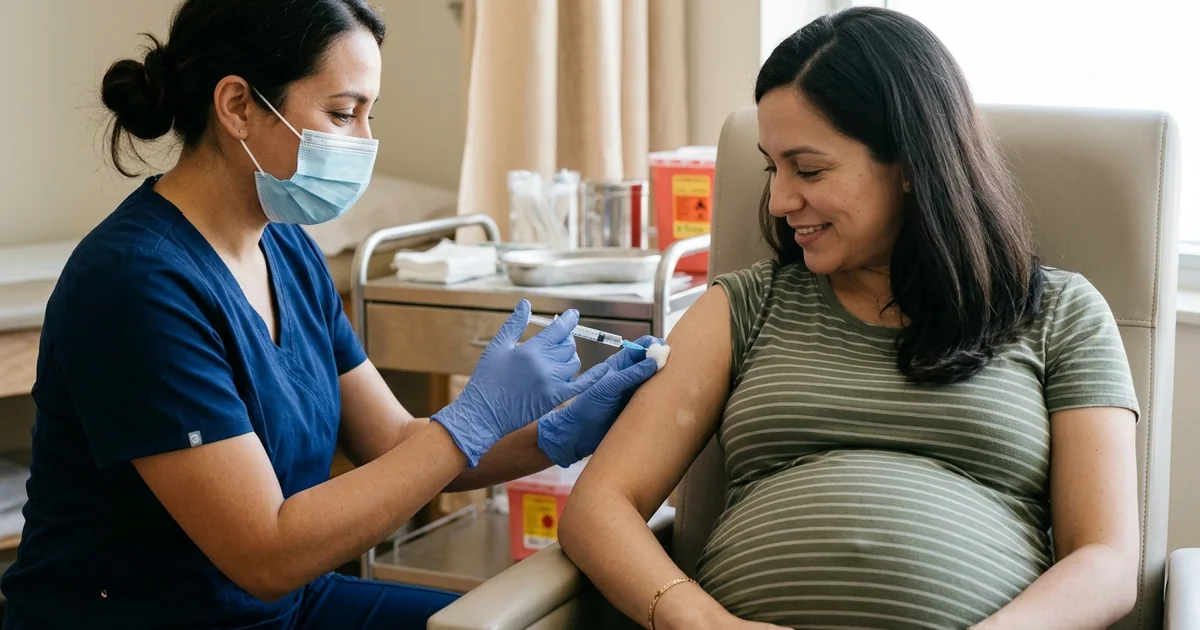
Vaccines in pregnancy: protecting two people at once
- Getting vaccinated while pregnant protects two people: the antibodies you make cross to your baby and shield them through their first months.
- The vaccines classically offered in pregnancy are whooping cough (in each pregnancy) and flu (in season).
- Depending on your country and the season, RSV and COVID protection may be added too.
- "Live" vaccines such as MMR and chickenpox are generally not given during pregnancy — those are checked beforehand.
- The exact recommendations shift and differ between countries, so your midwife or doctor holds the up-to-date version for your situation.
Why this is in the news now
Maternal vaccination is having a moment in the headlines because the guidance was refreshed over 2025 and 2026, including an updated statement from the American College of Obstetricians and Gynecologists (ACOG) covering COVID, flu and RSV. Updates like that are normal — this is a field that keeps pace with each season and each new tool — but they can also feel unsettling when they land in your feed mid-pregnancy. So it's worth stepping back from the noise and looking at what's actually stable underneath, and what simply varies.
What's well established
The core idea barely moves: pregnancy changes how your immune system behaves, and some infections — flu and COVID among them — can hit harder when you're expecting. At the same time, a newborn is too young to be vaccinated in those first weeks, so they lean heavily on the antibodies you pass across the placenta. That's the whole logic of maternal vaccination: you get protected, and your baby arrives already carrying some of that protection. Whooping cough is the clearest example — being vaccinated during pregnancy is what shields your infant from birth, before they're old enough for their own doses. Flu vaccination is likewise recommended during flu season, at any stage of pregnancy. These are inactivated vaccines that have been widely used in pregnant women and are closely monitored.
What varies by country and season
This is the part that genuinely differs from place to place — and it's why no article should hand you a fixed timetable. RSV is a good illustration: recent strategies to protect newborns exist, and depending on the country that can mean a seasonal vaccine given to the mother or immunising the baby directly after birth. COVID guidance follows whatever your local authorities currently advise. And the "live" vaccines, like MMR and chickenpox, are the mirror image of the story above: they're generally not given during pregnancy, so the moment to check your status is before you conceive or, failing that, with your care team. Because the exact windows, doses and combinations move around by country and season, the consultation — not the internet — is what settles what's right for you.
What it means for you
The practical takeaway is calm and short: the vaccines offered in pregnancy are there to protect both you and a baby who can't yet protect themselves, and the details are a conversation to have with the person who knows your history. You don't need to memorise schedules or referee competing sources — you need one good chat with your midwife or doctor, and a record they can read. Everything else flows from that.
Also worth reading: Counting your baby's movements · Packing your hospital bag
Keep every appointment in one place
Mama4care helps you keep track of your antenatal appointments and the questions you want to raise — so the vaccine chat, and everything else, doesn't slip through the cracks.
Download the appSources
Information current as of July 19, 2026. Recommendations change over time, and your healthcare professional remains the reference for your situation.
This article is for information only and has been reviewed by the Mama4care team. It does not replace medical advice: for any question about your health or your baby's, talk to your midwife, doctor or paediatrician. In an emergency, call your local emergency number.