
Expressing and storing breast milk: the practical, stress-free guide
Expressing your milk opens up a little freedom: someone else can give a feed, you can build a small stash before going back to work, and you can ease a full, uncomfortable breast. It can feel technical at first, but it quickly falls into a rhythm of its own. Here is the practical side — the why, the how, and above all how to store your milk safely — all without pressure.
Why express your milk
There are as many good reasons as there are mums. You might be going back to work and want your baby to keep having your milk. You might want to build up a stash so a partner or grandparent can share a feed. Expressing can also relieve an engorged breast when it feels hard and full, keep your supply going if your baby isn't feeding directly for a while, or feed a baby who is finding it hard to latch. Whatever your reason, it is entirely yours — there is no "right" amount and no competition.
How to express, by hand or with a pump
You can express by hand or with a manual or electric pump — many mums use a mix depending on the moment. Start with clean hands and clean, sterilised equipment. Then give yourself the best conditions: expressing works best when you are relaxed, because the let-down reflex that releases the milk runs on oxytocin, the calm-and-connection hormone. Warmth, a gentle breast massage, and having your baby nearby — or even just a photo, a muslin that smells of them, or the sound of them — all help the milk flow. If you're using a pump, make sure the funnel (flange) fits: your nipple should move freely in the tunnel, centred, with no painful rubbing. The right size makes all the difference between a chore and an easy session.
Storing your milk: the safe timings
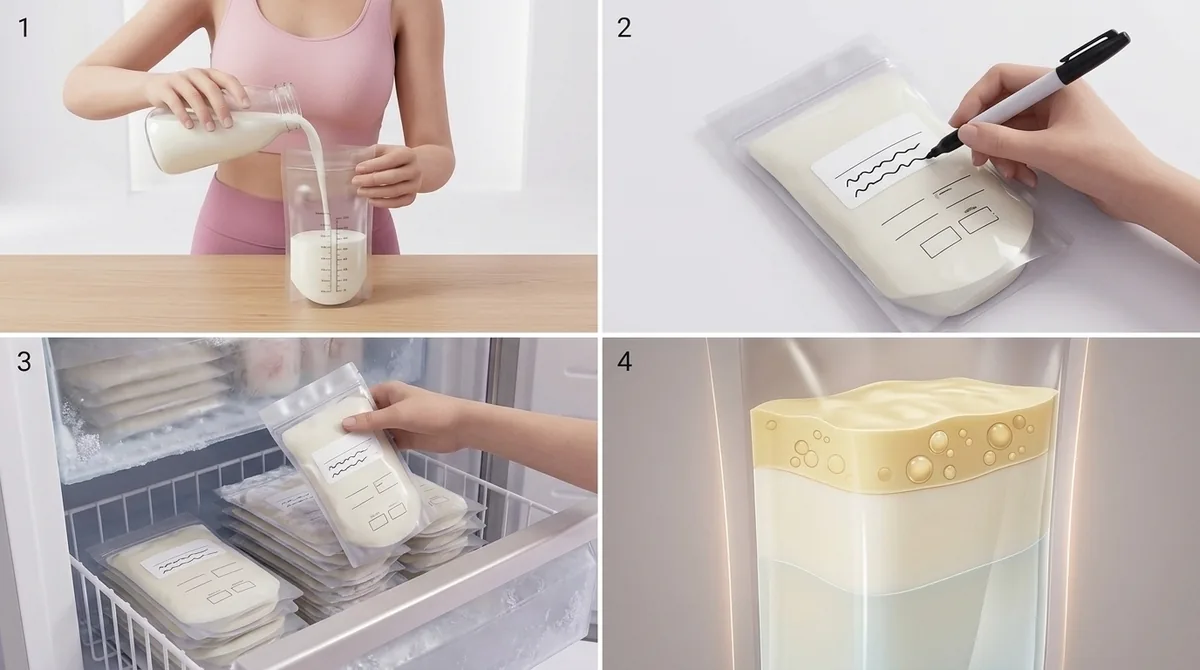
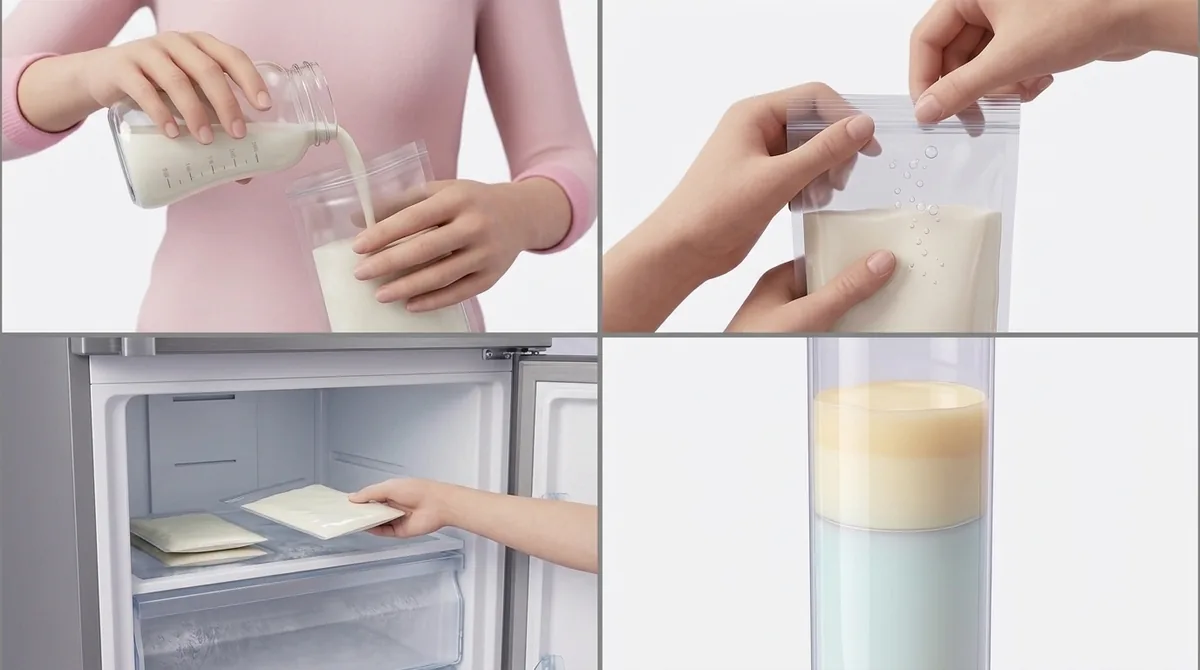
This is where a few clear numbers really help. Freshly expressed breast milk keeps at room temperature for about 4 hours, in the fridge (around 4 °C) for 3 to 5 days, and in the freezer for around 6 months. A few simple habits keep it safe and easy to use: date every container so you use the oldest first, and fill each one only about three-quarters full, because milk expands as it freezes and a too-full bag can split. Small amounts also thaw faster and waste less, so storing in modest portions is often the practical choice.
Thawing and warming, gently
Thaw frozen milk slowly in the fridge, or more quickly by standing the container under warm running water. To warm milk for a feed, warm water is all you need. As with formula, never use the microwave: it heats unevenly and creates hot spots. A couple of other things worth knowing so you don't worry: don't re-freeze milk once it has thawed, use thawed milk fairly soon, and don't be surprised if your milk separates into layers or smells a little different — a gentle swirl brings it back together, and both are completely normal.
Your questions, answered
When should I start expressing?
There's no single rule — it depends on your reasons. Many mums wait until breastfeeding feels settled before building a stash, while others express earlier to relieve fullness or support supply. If you're planning around a return to work or have a specific need, your midwife or a lactation consultant can help you time it.
How long does breast milk keep?
As a safe guide: about 4 hours at room temperature, 3 to 5 days in the fridge at around 4 °C, and around 6 months in the freezer. Date each container and use the oldest first.
Can I warm the milk in the microwave?
No. Microwaves heat unevenly and create hot spots that can burn your baby's mouth. Thaw in the fridge or under warm running water, and warm gently in warm water — then test a few drops on your wrist.
My milk smells different and has two layers — is that normal?
Yes, both are normal. Milk naturally separates, with the creamier part rising to the top; a gentle swirl mixes it again. A slight change in smell after storage is also common and doesn't mean the milk has gone off.
Also worth reading: Preparing and sterilising bottles: the safe method · Breastfeeding positions: finding what works for you
Keep an eye on your feeds and your stash
With Mama4care, log feeds and expressing sessions in a couple of taps, keep track of what's in the fridge and freezer, and ask the assistant your questions about milk and supply whenever they come up.
Download the appSources
This article is for information only and has been reviewed by the Mama4care team. It does not replace medical advice: for any question about your health or your baby's, talk to your midwife, doctor or paediatrician. In an emergency, call your local emergency number.