
Infant colic: the massages and moves that soothe
It's 7 p.m., your baby has eaten, their nappy is clean, they're thriving on the scale — and yet they're screaming, fists clenched, legs pulled up over the tummy. If this scene rings a bell, breathe: colic affects up to one baby in four, it's a sign of no illness, and it goes away on its own. In the meantime, there are moves that soothe — massage first among them.
First, put it into words: what is colic?
We talk about colic when a healthy baby, who feeds well and grows well, cries intensely and is hard to calm, often at the end of the day — the classic marker being more than 3 hours a day, more than 3 days a week. It begins around 2-3 weeks, peaks around 6 weeks, and almost always fades between 3 and 4 months. It's no one's fault: not your milk, not the way you hold them, not you.
The tummy massage, how to do it
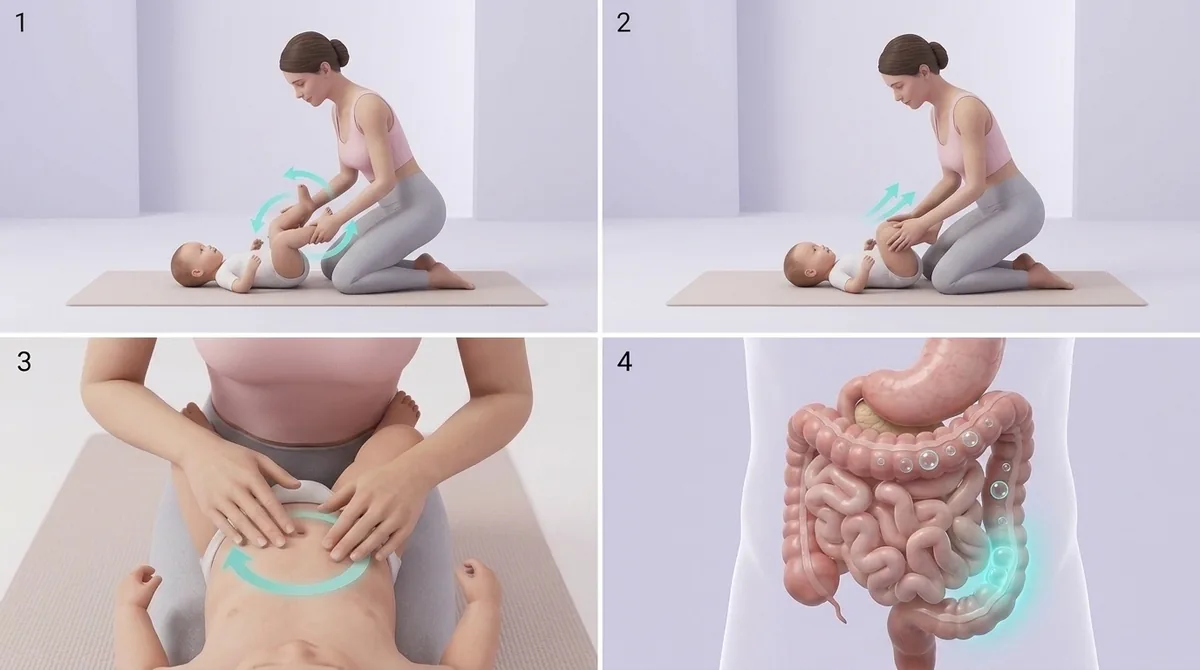
The timing matters as much as the move: choose a period of calm wakefulness, at least 30 minutes after a feed — never right after the breast or bottle. Baby on their back, on a flat surface, warm room, warmed hands, and perhaps a drop of baby-suitable oil. Then, gently:
1. Clockwise circles. With your palm flat, massage the tummy in slow circles clockwise — that's the direction of flow in the intestine, around the navel. 2. Bicycle legs. Take their ankles and gently pedal their legs, like a little bicycle. 3. Knees to the tummy. Fold both knees together against the tummy, hold for a few seconds, release. Repeat the whole thing for as long as your baby enjoys it — if they stiffen or protest, stop and try again later.
Burping, the most underrated anti-colic move
Some of the air swallowed during feeds ends up later in the intestine. Take the time to burp after every feed — and even halfway through the bottle if your baby drinks fast: held upright against your shoulder or sitting on your lap, back nice and straight, a few gentle pats between the shoulder blades. No burp after 10-15 minutes despite the upright position? It's not compulsory every time, so don't persist.
When the massage isn't enough
On crisis evenings, alternate the safe bets: babywearing tummy against you (the warmth of your body on their tummy often works better than a hot water bottle), skin-to-skin, a dimmed atmosphere with soft white noise, a walk or slow rocking. And if nothing works: laying your baby safely in their crib, on their back, and stepping out to catch your breath for five minutes is the move of a good parent, not abandonment. A baby who cries despite everything is not in danger — a parent at the end of their rope is.
Your questions, answered
Should I change formula (or stop breastfeeding) because of colic?
No, not on your own initiative: in the vast majority of cases, colic comes from neither breast milk nor infant formula, and breastfeeding remains recommended. If an intolerance is suspected, that's a decision to make with your doctor, never alone in front of the shelf.
Is a hot water bottle on the tummy a good idea?
Heat soothes, but a baby's skin burns quickly: avoid the hot water bottle directly. The safe version is the warmth of your body — baby carried tummy against you, or their tummy resting on your forearm, head in the crook of your elbow (the "tiger hold").
Do anti-colic drops and probiotics work?
The evidence is limited and varies by product. Some paediatricians suggest them case by case: talk to yours before buying anything, and be wary of miracle remedies sold online.
At what age should I massage, and for how long?
From the first weeks, as long as your baby enjoys it: 5 to 10 minutes is plenty. The best indicator is your baby — relaxed and attentive, carry on; tense or grumpy, put it off for later.
Spot the rhythm behind the crying
With Mama4care, note feeds, burps and crying with one tap: the app reveals the rhythm of the difficult evenings, and the assistant answers your questions — even during the 7 p.m. meltdown.
Download the appSources
This article is for information only and has been reviewed by the Mama4care team. It does not replace medical advice: for any question about your health or your baby's, talk to your midwife, doctor or paediatrician. In an emergency, call your local emergency number.